
 Čeština
 Deutsch
 Español
 Français
 Italiano
 Қазақ
Қазақ
 Polski
 Русский
 Українська
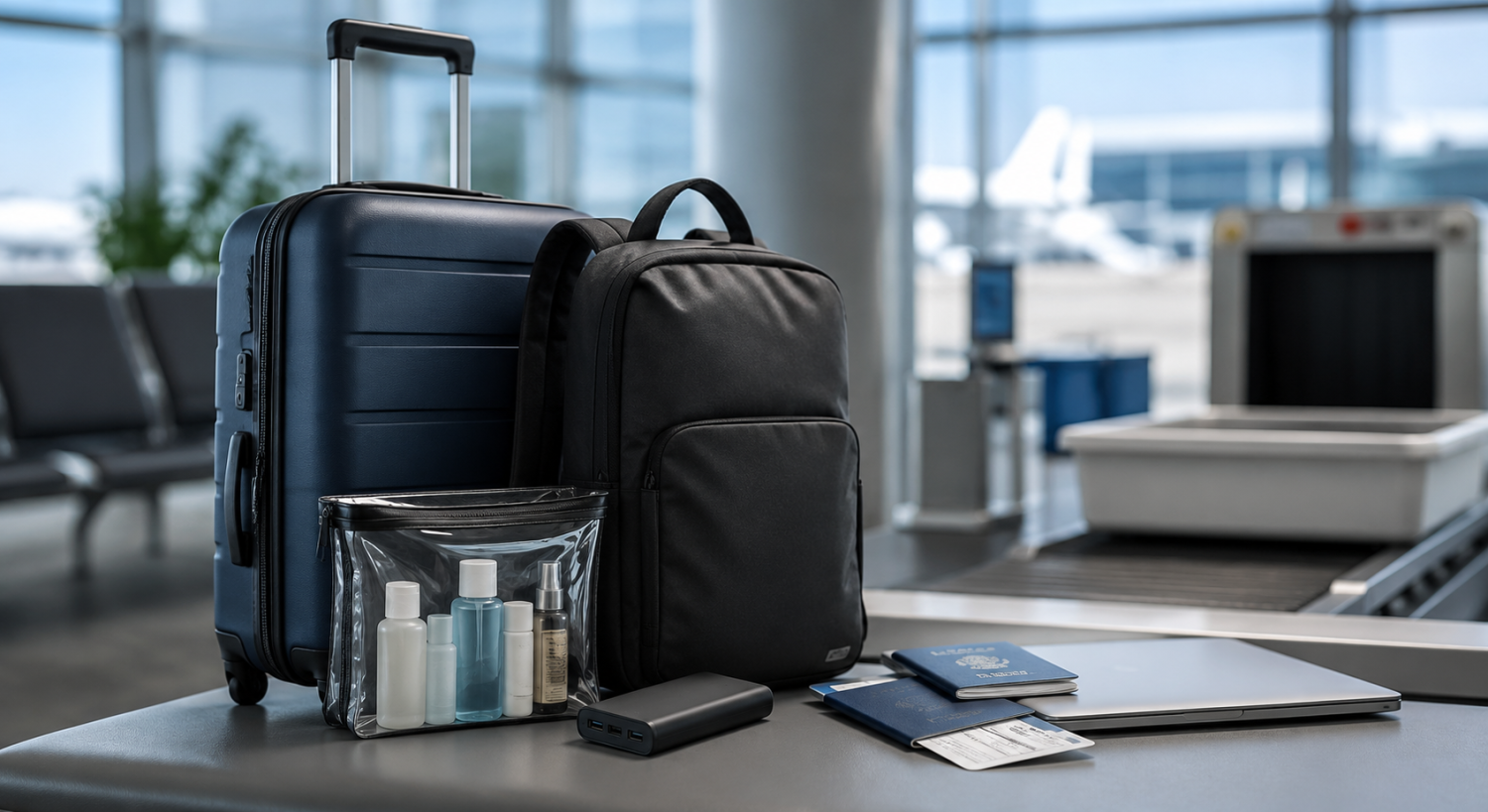
Carry-On Baggage in 2026: What to Know Before You Fly
Carry-on baggage rules in 2026 have not necessarily become more complicated — they have become more different. That is what most often confuses travelers: one airline includes only a small backpack, another allows an additional cabin bag, one airport still checks liquids the classic way, while another already uses a more modern process. To help your trip start without stress at security or at the gate, the Travellizy team has gathered the most important things to know in one guide.
The most useful rule for 2026 is simple: check not only the airline, but also the fare, departure airport and operating carrier. This is where most unpleasant surprises tend to hide.
The Main Point: Carry-On Is No Longer “One Small Suitcase for Everyone”
A few years ago, many travelers relied on a general idea of “backpack plus small suitcase”. Today, that is not enough. Even on the same route, rules may vary depending on the fare. And if you have a connection or the flight is operated by another carrier, that airline’s rules may apply instead.
That is why, before flying, it is important to look not at old habits, but at the exact conditions of your ticket. The carrier’s official rules are not just formal wording — they are what may actually be checked at check-in, at the gate and during boarding.
What to Check Before Your Flight: A Quick Matrix
| What to check | Why it matters | Where to check |
|---|---|---|
| Fare | Your fare often determines whether only a personal item is included or whether a full cabin bag is included too. | In your booking and on the airline’s baggage / carry-on baggage page. |
| Operating carrier | If another airline operates the flight, its rules may matter more than the brand shown on your ticket. | In the flight details: “operated by…”. |
| Departure airport | Especially important for liquids and security screening: procedures may differ. | On the official airport website. |
| Items in your bag | Power banks, liquids, aerosols, cosmetics, laptops and other electronics have specific rules. | On baggage rules / dangerous goods / security rules pages. |
1. Size and Weight: The Most Common Source of Boarding Stress
The first thing to check is not just “do I have carry-on baggage”, but what exact size and weight are allowed. In 2026, this remains one of the most common traps: a passenger believes they are flying “with carry-on only”, but their fare actually includes only a personal item under the seat.
A major airline example shows this clearly: Lufthansa separates personal item from carry-on baggage, and the allowance depends on travel class and fare. For many fares, the personal item must be compact, while a full cabin bag is allowed separately — but not always. That is why the old logic of “I flew like this before” works worse and worse in 2026.
Another important point: airlines do check carry-on baggage. If your bag does not meet the size or weight rules, it may be sent to the hold at the airport. This is not only inconvenient, but often more expensive than adding baggage in advance.
2. Liquids: The Basic Rule Still Matters
In short: the 100 ml rule has not disappeared as a basic standard. For flights within the EU and connections from the EU, the official rule many carriers still rely on is this: each container of liquid or gel must be up to 100 ml, and all containers must fit into one transparent bag with a capacity of up to 1 liter.
One important detail many travelers miss: what matters is the maximum capacity printed on the container, not how much is actually left inside. If the bottle is 150 ml but half empty, it still does not fit the classic rule.
| What counts as liquid | What the rule means in practice |
|---|---|
| Water, drinks, perfume, creams, gels, pastes, aerosols, syrups, foams | Each item — up to 100 ml; all together — in one transparent bag of up to 1 liter |
| Travel-size cosmetics | Usually the easiest option for carry-on baggage |
| Medication and baby food | Often have exceptions, but they should be prepared separately and shown at security if needed |
Now for the important “but”. In 2026, there are indeed airports where new scanners may make the process easier or more technologically advanced. In practice, however, this does not mean you can automatically ignore the 100 ml rule. The process still depends on the specific airport, sometimes even the terminal, and rules for the return flight may be different.
3. Power Bank: Cabin Only, Not Checked Baggage
For power banks in 2026, remember one simple sentence: a portable battery must be in your carry-on baggage, not in checked baggage. This is a safety rule, and airlines take it very seriously.
Moreover, if your cabin bag is taken at the gate and sent to the hold — for example, because there is not enough space in the cabin — you must remove your power bank, laptop, tablet and other battery-powered devices and take them with you into the cabin. This follows the logic of modern safety rules: battery-powered devices should remain where the crew can respond quickly if there is a problem.
For frequent travelers and business trips, there is another practical takeaway: do not pack your power bank “somewhere at the bottom of the suitcase”. Keep it easy to reach — it is calmer at security and during boarding.
4. Personal Item: A Small Fare Detail That Often Decides Everything
Another confusing area is the personal item. In many fares, it is the personal item that is included in the ticket price, not a full cabin bag. A personal item is something that must fit under the seat in front of you: a backpack, laptop bag, compact handbag or small daypack.
It is important not to think in terms of “small bag means fine”. For the airline, what matters is not your subjective impression, but exact centimeters. On official airline pages, carriers often state the size of the personal item separately, and this is what may be checked at the airport.
If you are flying on a short business trip, this is especially relevant. One laptop, charger, documents, light clothing and a cosmetics pouch — and the bag can easily exceed the limits of a “personal item”. If you have a packed work schedule and do not want to start the day arguing at the gate, check the fare honestly from the start.
5. If You Have Several Flights or Several Airlines
This is something travelers often underestimate. If your route consists of several segments, the rule “I checked the first airline’s website” may not save you. The official logic is simple: if the flight is operated by another carrier, you need to check that carrier’s rules. And if the requirements differ, follow the stricter option.
A connection is not the time for assumptions. If one segment is more generous and another is stricter, your baggage will not be judged by the most convenient scenario, but by the rules that actually apply to that segment.
Mini Scenarios: How to Think Practically
| Scenario | What to check first |
|---|---|
| Short city break | Whether a personal item is enough or you need a full cabin bag |
| Business trip | Laptop, power bank, documents and chargers should be easy to access and fit the allowance |
| Connecting itinerary | Check the operating carrier and departure airport rules at every stage |
| Returning with duty free | Do not assume “they allowed it there, so they will allow it here”: return rules may differ |
What to Do 5 Minutes Before Packing
Instead of a huge checklist, use a short ritual that actually works.
Open your booking and check what exactly is included in your fare. Then open the airline’s carry-on baggage rules page. After that, check the official website of your departure airport — especially the security or hand baggage section. Only then pack liquids, electronics and your personal item.
It may look like a small step, but this habit is the best protection against extra fees, delays and unpleasant surprises at security.
Where to Check the Rules Officially
If you want to verify everything before your flight, use official sources only:
1. Airline website — pages such as baggage, carry-on baggage, dangerous goods.
2. Departure airport website — security, cabin baggage, liquids sections.
3. Your booking details — this usually shows the fare and, if relevant, the operating carrier.
As an example, you can check the official Lufthansa page: Carry-on baggage | Lufthansa.
Information is accurate at the time of publication. Carry-on, liquids, battery and personal item rules may change depending on the airline, route, fare and airport. Always check official sources before traveling.
Bottom Line: In 2026, the Winner Is Not the Traveler Who “Has Flown a Hundred Times”, but the One Who Checked the Rules Yesterday
Carry-on baggage in 2026 is no longer about general assumptions — it is about specifics. Size and weight depend on the fare. Liquids are still safest when packed according to the 100 ml rule unless you have checked the airport. Power banks belong in the cabin only. And a personal item can be either a convenient advantage or a source of extra costs — depending on whether you checked the conditions in advance.
Planning your next trip? On Travellizy, you can find convenient flights, while we help you feel confident even before boarding begins.
More Useful Travel Tips from Travellizy
Want more beautiful, useful and interesting travel content? Visit the official Travellizy Instagram page — there you will find more inspiration, travel ideas and practical tips.
Also subscribe to the official Travellizy Telegram channel: there is more beautiful, useful and up-to-date content, plus an easy way to move on to booking flights.
Read Also
How to Choose a Hotel for a Business Trip
Iceland or Norway: What to Choose for Your Next Trip
Where to Travel This Month: Destinations That Inspire
Tags: #CarryOnBaggage #AirTravel #Travel2026 #LiquidsOnPlane #PowerBank #Travellizy #Flights #TravelTips